



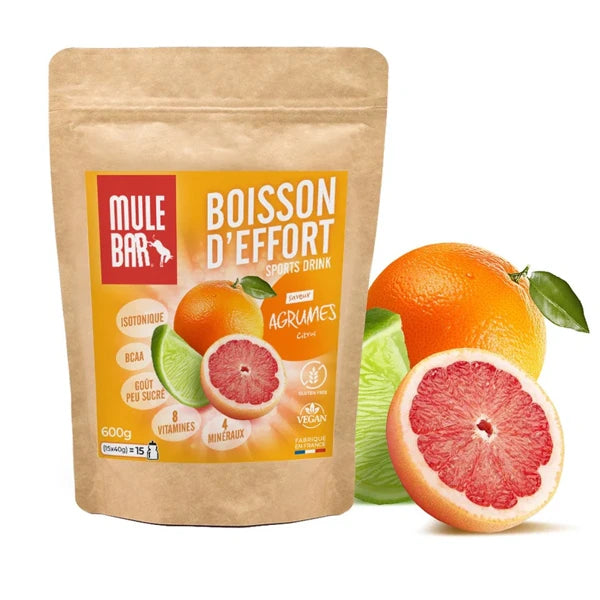
Endurance Drink (600g) - Citrus Fruits
- 100% natural ingredients
- AFNOR NF EN 17444 anti-doping certification
- Made in Clermont-Ferrand
- 600g = 15 servings of 40g = 15 500ml bottles
The Mulebar exercise drink was developed with a French specialist in sports drink formulation. They supply numerous professional football, basketball, cycling and rugby teams, as well as many marathon runners, trail runners and triathletes, with customized formulations. You can easily compare the major differences in formulation and dosages with the leading brands on the market in the photos of this product listing. Our guiding principle is that one bottle provides 1/3 of the NRV (Nutrient Reference Values) for each vitamin. There is no point in overdosing when consuming several bottles throughout the day.
An exercise drink, also called an energy drink, serves a dual purpose during physical activity:
- Provide consistent energy (without a blood sugar spike) and ensure healthy metabolism (maintaining glycogen stores).
- Provide mineral salts and trace elements (electrolytes), amino acids (BCAA) and vitamins to replace losses caused by perspiration and promote water absorption by the body.
Here are its main features, detailed in the “benefits” tab:
- Isotonic drink. This means it has the same concentration as blood, so it is absorbed very easily. A drink that is too concentrated (hypertonic) slows digestion and limits hydration. A drink that is too diluted (hypotonic) promotes hydration but at the expense of nutrient absorption.
- Three-source energy intake (maltodextrin, sucrose and fructose) for both rapid and sustained energy release (35.5 g of carbohydrates per serving), but only 17.5 g of sugar to prevent nausea after several hours.
- 4 minerals (sodium, magnesium, potassium, zinc) to replace mineral salts lost through perspiration and maintain good hydration balance (cramp prevention).
- 8 vitamins (B1, B2, B3, B6, C, D, E) to reduce muscle fatigue and support healthy metabolism (energy production).
- BCAA amino acids (Leucine, Isoleucine, Valine) to support post-exercise muscle recovery.
- Baking soda to counteract the adverse effects of lactic acid in muscle cells.
- Pleasant fruity flavors.
Unlike some energy drinks, Mulebar's sports drink stands out for its natural flavors, lack of acidity and preservatives, and perfect dissolution in water. You will not find any residue at the bottom of the bottle, which often causes digestive problems when ingested.
Finally, its Doypack packaging ensures excellent preservation (protection against air and light), takes up minimal space, and uses no plastic.
A three-source energy supply:
It provides both a rapid release of energy and energy that lasts over time, and is made up of:
- Maltodextrin: this is a fast source of energy. It is often consumed before, during, and after exercise to replenish muscle glycogen stores and improve athletic performance. Maltodextrin is also used for hydration during long-duration activities (endurance sports) and to promote better muscle recovery. Our maltodextrin has a DE (dextrose equivalent) of 19, which corresponds to a relatively slow release of energy. Many maltodextrins have very high DE values, causing blood sugar spikes. Few brands disclose this figure because it is generally very high.
- Sucrose (or table sugar): this is a sugar derived from sugar beets or sugar cane, found mainly in table sugar. Made up of fructose and glucose, its main benefit is providing energy.
- Fructose: its sweetening power is greater than that of sucrose. It is very easy for the liver to digest.
BCAA (amino acids):
BCAA are among the 9 essential amino acids. They are involved in the production of proteins that the body cannot produce itself. The body therefore obtains them through food and supplementation. They have a significant impact on muscle development. In fact, they contribute to muscle regeneration and promote good recovery after exercise.
- Leucine: it contributes to building muscle mass. Above all, it helps slow the breakdown of muscle cells caused by oxidative stress. This stress is all the greater when physical exertion is intense, due to increased oxygenation of the blood.
- Isoleucine: It is a source of energy for the muscles. It promotes muscle growth by stimulating their sugar consumption.
- Valine: It helps build muscle by facilitating glucose transport to muscle cells during exercise.
A combination of 8 vitamins, each with its own benefits:
B vitamins:
They facilitate energy metabolism, namely the release of energy contained in food. They also help prevent mental fatigue by stimulating the central nervous system. Most B vitamins are not stored in sufficient quantities in the body.
- Vitamin B1 (thiamine): It helps convert carbohydrates into energy. It is essential for the proper functioning of the muscles, including the heart muscle. Recommended daily intake for an adult: 1.1 mg
- Vitamin B2 (riboflavin): It also helps release energy from food. It contributes to normal iron metabolism and helps maintain a normal red blood cell count. This is why it supports the normal functioning of the central nervous system and helps reduce fatigue. Recommended daily intake for an adult: 1.4 mg
- Vitamin B3 (niacin): It helps the nervous system function properly. Recommended daily intake for an adult: 16 mg
- Vitamin B6 (pyridoxine): It plays a role in the metabolism of several amino acids and contributes to the production of red blood cells. It supports normal energy metabolism and helps reduce fatigue. Recommended daily intake for an adult: 1.4 mg
- Vitamin B9 (folic acid): It contributes to the production and oxygenation of red blood cells. It helps reduce fatigue. Recommended daily intake for an adult: 200 µg
4 minerals that need to be replenished after being lost through sweating:
- Sodium (Na): It regulates blood pressure, helps maintain fluid balance in the body, and contributes to the normal functioning of the muscles and nerves. Recommended daily intake for an adult: 2000 mg, equivalent to 5 g of salt
- Potassium (K): It contributes to the normal functioning of the nervous system, normal muscle function, and the maintenance of normal blood pressure. Recommended daily intake for an adult: 3500 mg
- Magnesium (Mg): It contributes to electrolyte balance and energy metabolism. Magnesium contributes to the proper functioning of the nervous and muscular systems. It contributes to healthy bones and teeth. Recommended daily intake for an adult: 350 mg for men and 300 mg for women.
- Zinc (Zn): This trace element, present in very small amounts in the human body, is involved in the activity of more than 300 enzymes. In particular, it stimulates the immune system, supports hormone synthesis, and helps combat cellular aging. Recommended daily intake for an adult: 11 mg for men and 8 mg for women. For vegans, it is 13 mg and 11 mg, respectively.
Bicarbonates:
They help counter muscle acidity caused by physical exertion (lactic acid), prevent cramps, and promote better recovery. They also promote lean mass gain.
Directions for use:
Dosage: 1⅓ scoops per 500 ml bottle, i.e. 40 g of powder per 500 ml bottle
It is essential to start hydrating well several hours before your effort. You are then advised to maintain constant hydration and blood sugar levels by drinking a sip regularly, every 15 minutes for example, without waiting until you feel thirsty, as by then it will be too late to prevent cramps in particular.
The human body dislikes the “yo-yo” effect. That is why our energy gels come with a resealable cap for divided consumption.
We recommend drinking at least one 500 ml bottle per hour. Each athlete’s needs will vary depending on the type of sport, its intensity, body size, or the outdoor temperature. It is during your training sessions that you can gradually establish your hydration routine.
Ingredients:
Corn maltodextrin, sucrose, fructose, natural flavors: lime, grapefruit and orange, sodium bicarbonate, BCAA (L-leucine, L-isoleucine, L-valine), citric acid, potassium bicarbonate, magnesium citrate, coloring ingredients: concentrated beetroot juice, concentrated acerola juice, lemon juice and turmeric powder, vitamins (C, B3, E, B1, B2, B6, B9, D), zinc bisglycinate.
Nutritional Information:

Colissimo / Mondial Relay: for orders placed before 12:00 p.m., dispatch the same day (except Mondial Relay on Mondays — no transportation)
GLS home delivery: for orders placed before 12:00 p.m., dispatch the same day
For information, here are the delivery times (hours/business days after dispatch):
Colissimo: 24–48 hours
Mondial Relay: 36–72 hours (please note: Mondial Relay does not operate on Mondays)
GLS home delivery: BE-LU DE-NL: 24–48 hours — FRANCE: 36–72 hours
To serve you better, we negotiate attractive rates with professional freight carriers.