


How to recover properly after a marathon?
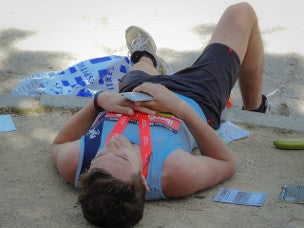
Recovering from a marathon is an essential part of a training plan that runners far too often neglect.
Unfortunately, if you do not prepare for recovery, you will increase the risk of injury, as well as the recovery time your body needs... and that is not necessarily good for your health.
Most often, runners who do not follow a good post-marathon recovery plan plateau in their subsequent performance or suffer from overtraining symptoms.
Today, we will give you the best ways to recover from a marathon. This article will discuss the scientific evidence behind post-marathon fatigue, so that you understand what your body goes through and can prepare for your race to achieve optimal performance.
Next, we will provide you with a post-marathon recovery plan to help you recover in the best possible way. Discover all our recovery products
What happens to my body when I run a marathon?
Marathons are demanding on the body—there is no doubt about it.
The muscles, hormones, tendons, cells, and almost all physiological systems are pushed to their limits during the race.
Whether you are an experienced marathon runner or a casual amateur, 42 km is 42 km. Your body undergoes enormous physical strain, in addition to the stress you put it through during your training.
Here is a list of some of the physiological systems affected during a marathon, along with their recovery time.
=> Muscles
Muscle soreness and fatigue are the most obvious signs of the damage caused by the body's effort over the marathon distance.
A scientific study conducted on the calf muscles of marathon runners concluded that intensive training and the marathon itself induce inflammation and muscle fiber necrosis, significantly impairing muscle strength and endurance for 14 days after the marathon.
As a result, your muscles will need approximately 2 weeks after the marathon to return to full strength.
=> Cellular damage
Cellular damage after the marathon, including oxidative damage, increased creatine kinase (CK) production—a marker indicating damage to skeletal and cardiac muscle tissue—and increased myoglobin levels in the bloodstream (which often causes blood to appear in the urine).
One study concluded that CK damage persists for more than 7 days after the marathon, while another study confirmed the presence of myoglobin in the bloodstream 3–4 days after the race.
These two studies clearly indicate that the body needs at least 7–10 days of rest after a marathon to fully recover from the cellular damage caused during the race.
These markers, along with a suppressed immune system, are the main reasons why the optimal marathon recovery program avoids overtraining during the first 2–3 days.
=> Immune system
After a marathon, the immune system is put under considerable strain, increasing the risk of catching a cold or the flu.
In addition, a weakened immune system is one of the main causes of overtraining. A recent study confirms that the immune system is compromised for up to three days after a marathon and is a major factor in overtraining syndrome.
Therefore, it is essential that you rest as much as possible during the three days following a marathon and focus on consuming nutrient-rich, healthy foods.
Research clearly indicates that the marathon causes significant damage to the muscles, cells, and immune system for 3 to 14 days after the race.
Therefore, it is essential that all marathon runners have a 2–3-week marathon recovery protocol focused on resting and rejuvenating these physiological systems. Discover all our recovery products
How to recover after running a marathon
We will describe a nutrition, rehabilitation, cross-training, and running program for the 3 weeks following a marathon. This rehabilitation plan will help you recover faster and return to training as quickly as possible.
=> Immediately after the race
The immediate post-race recovery protocol can be a little difficult to plan in advance.
Focus most of your energy on nutrition and your pre-race strategy. These points are simply here to give you advice for after the race.
- After crossing the finish line, try to get something warm on your back. You will surely feel cold very quickly, and even though it won't help you recover, warming up will make you feel much better.
- Try to find something to eat. Bananas, recovery bars, recovery drinks and recovery, fruit, and bread are all good options.
Many marathon runners can't eat shortly after finishing; wait a little while and eat when you get home.
- For those of you who are braver, a cold bath will be very effective for recovery.
Fill the bathtub with ice and cold water and immerse your legs for 15 minutes. The water doesn't need to be too cold.
After your ice bath, you can take a nap or go for a walk to try to relax your legs.
At this point, you've done everything you can do for the day. Get plenty of rest.
=> Days 1-3
Running: None
Cross-training: None either
Recovery tips and tricks:
Soak your legs in a cold bath (yes, again!) for 10-15 minutes and stretch well afterward.
Eat fruit, carbohydrates, and protein. Carbohydrates and protein will help repair muscle damage, while fruit will give you a boost of vitamin C and antioxidants to help fight free-radical damage and boost your immune system.
A light massage will help relax your muscles. Don't schedule a deep-tissue massage yet; just a gentle massage / stroking or light rolling with the stick.
=> Days 4-7
Training: One day, 2 to 4 km at an easy pace.
Two days later, an easy effort of 30 to 40 minutes. The focus is on getting blood flowing to the legs, not on building fitness.
Recovery tips and tricks: Continue eating a healthy diet.
Now is the time to get a deep-tissue massage if you still have areas that are really bothering you or are injured.
Cold-hot contrast bath for the lower body. To prepare the contrast bath, take two large garbage bags and fill one with hot water (a hot bath temperature) and the other with ice-cold water (cold enough that ice does not melt). Put your entire body in the cold water. Hold for 5 minutes, then switch to the hot water for 5 minutes. Repeat 2 or 3 times, ending with the cold water. This helps flush blood into and out of the area, facilitating healing.
About an hour before bed, massage your legs with a stick or self-massager, then soak them in a hot bath with 3 cups of salt and 1 cup of baking soda for 10 to 15 minutes. After soaking, stretch really well and relax.
=> Days 7-14
Running: three or four days of 6 to 9 km at a very easy pace.
Cross-training: optional — three sessions in total. One easy session and two moderate-effort sessions lasting 30 to 45 minutes.
=> Days 14-21
Training: Slowly begin rebuilding a full run. Four to five sets of 4 to 8 km with 4 x 20 seconds of walking after each run.
1 easy session, 1 moderate session, and 1 hard session lasting 40 to 50 minutes.
Note that ensuring a proper recovery is much more important so that you can train even better for your next racing goal.
If you don't allow yourself enough time to recover, you will simply set back your good training sessions and push yourself to the brink of overtraining.
Try not to plan a serious race until 6 weeks after your marathon.
We know you'll be eager to get back to it. However, your results won't be as good as they could be if you don't wait a few weeks and let your body recover properly. Discover all our recovery products
Patience is a virtue, and it will pay off in the end!
Discover our products dedicated to marathons now.


You may also be interested in: