


Acid-base balance by Guillaume Klein
Physical activity has many positive effects on optimizing physical and mental health.

However, regular and prolonged exertion, particularly in endurance sports, can promote an acid-base imbalance in the body by creating acid loads that have harmful effects on our organism.
1) Understanding acid-base balance
Our body functions within a narrow blood pH range of 7.36 to 7.42; beyond this limit, our health is at risk.
The body has regulatory mechanisms to balance pH within this range, allowing different acids to be eliminated through the lungs, kidneys, and intracellular and extracellular buffer systems.
However, these mechanisms may prove insufficient due to excess acidity and no longer be able to perform their regulatory roles properly.
Factors causing imbalance:
- An unbalanced diet.
- A sedentary lifestyle.
- Excessive physical activity.
- Stress and excessive mental activity.
- Pollution.
2) The consequences of an excess of acid load
To combat acidosis, the body must make considerable efforts to balance blood pH and neutralize excess acidity.
It then draws on the bones’ alkaline reserves, using calcium, magnesium, and potassium salts, which are eliminated through the urine.
This phenomenon can cause demineralization, including a loss of bone mass.
Other consequences:
- Tendon and joint disorders.
- Muscle fatigue.
- Increased risk of kidney stones.
- Weakened nervous system.
In athletes, the acidification of the body is a phenomenon that must be regulated, as it could weaken the skeleton and cause stress fractures, as well as promote tendinopathies, muscle mass loss, and an increased risk of infection.
3) Controlling acidity through nutrition
The foods we consume daily during our meals have a direct impact on our body’s acidity and help restore balance.
The context of modern nutrition:
Today we have access to a substantial food supply, but this often comes at the expense of quality.
This abundance leads to excessive consumption of animal protein, dairy products, refined grains, processed foods, refined sugars and salts, soft drinks, and so on, which produce a harmful effect by acidifying the body.
Plants at the heart of balance:
Fruits and vegetables are the main dietary means of regulating acidity because they contain organic anions (citrates and malates) that neutralize acidifying loads.
Concentrations are generally higher in fruits than in vegetables, particularly in citrus fruits and kiwis, which have a higher average content of citrates and malates.
Vegetables are richer in potassium than fruits, but have a more balanced ratio of potassium to organic anions (citrates and malates).
- Citrate is found mainly in citrus fruits and kiwis, but also in potatoes and tomatoes.
- Malate predominates in apples, cherries, plums, eggplants, and cucumbers.
- Bananas are an exception because, unlike other fruits, they have a balanced ratio of potassium to organic anions.
Overall, all fruits and vegetables offer benefits and should be consumed in a varied and balanced way to ensure an optimal ratio of organic anions (citrates and malates) and potassium.
The fact that certain fruits and vegetables have an acidic taste does not mean that they are acidifying; take lemon, for example: it tastes acidic, notably because of the presence of citrates, but it is alkalinizing for the body.
However, for some people with metabolic weakness, it is preferable to limit their intake of acidic fruits and vegetables (citrus fruits, kiwis, berries, tomatoes, rhubarb, etc.), which are poorly oxidized and consequently acidify the body.
The PRAL value as an indicator of acidity:
This tool measures the potential renal acid load generated in the body per 100 g of food.
Whether a food is acidifying or alkalinizing depends on its nutritional composition, primarily its mineral composition and protein content.
Acidifying foods have a positive PRAL value, whereas alkalinizing foods have a negative PRAL value.
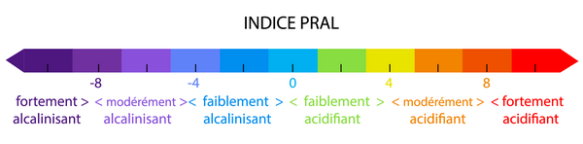
- Acidifying foods include animal products (meat, fish, eggs, and dairy products), grains, and legumes.
- Alkalinizing foods include vegetables, fruits, and spices.
Some examples:
- Acidifying foods:
- Parmesan: PRAL per 100g +34
- Emmental: PRAL per 100g +21
- Turkey: PRAL per 100g +10
- Beef: PRAL per 100g +8
- Egg: PRAL per 100g +8
- Cod: PRAL per 100g +7
- Spaghetti: PRAL per 100g +7
- White rice: PRAL per 100g +5
- Baguette: PRAL per 100g +4
- Lentils: PRAL per 100g +3
- Alkalizing foods:
- Raisin: PRAL per 100g -21
- Spinach: PRAL per 100g -14
- Banana: PRAL per 100g -6
- Celery: PRAL per 100g -5
- Carrot: PRAL per 100g -5
- Sweet potato: PRAL per 100g -4
- Tomato: PRAL per 100g -3
- Orange: PRAL per 100g -3
- Apple: PRAL per 100g -2
- Cucumber: PRAL per 100g -1
A food with a positive PRAL index (acidifying) should not be removed from the diet, but incorporated into a suitable meal that maintains the balance of the acid–base balance.
Although the PRAL index is useful for a general overview, it also has limitations: the calculation method lacks precision, and above all, it cannot account for individual metabolic capacity in regulating acids.
4) The athlete's case
Diet is fundamental to maintaining the body's acid–base balance, so it is particularly important to pay close attention to it around physical exertion, especially during the recovery phase.

After physical activity, the body enters a metabolic window that lasts from 30 minutes to 4 hours after the effort ends.
The objectives:
- Make up for effort-related losses from an energy standpoint.
- Optimize the body's ability to rebuild itself to promote recovery.
During this window, the body is therefore fully capable of receiving everything you give it in terms of food and hydration.
The athlete must therefore have an appropriate nutritional intake to replenish energy and mineral stores in a healthy way, while avoiding the creation of acid load.
For an alkalizing plate:
The foundation is to include plenty of fresh fruits and vegetables.
Avoid excess:
- Animal proteins.
- Dairy products.
- Cereals (rice, pasta, bread…).
Load up on carbohydrates and energy with alkalizing sources:
- Fresh fruit
- Dried fruits (apricots, figs, prunes…)
- Tubers, squash, and root vegetables (sweet potato, potato, Jerusalem artichoke, parsnip, butternut squash, carrot, beetroot,…)
Example:
- Green salad
- Grated raw beetroot.
- Assorted seasonal vegetables (cabbage, green beans, Swiss chard, broccoli, spinach, fennel…).
- 2 eggs (preferably soft-boiled or fried).
- 200 g of sweet potato.
- 1 unsweetened plant-based yogurt (soy, almond, coconut…).
- 1 banana.
Meal seasonings:
- Dressing: 1 to 2 tablespoons of a mixture of 50% extra virgin olive oil + 50% extra virgin omega-3 oil (rapeseed, flaxseed, walnut, camelina…) + fresh lemon juice and/or (cider vinegar, balsamic vinegar, tamari…) + 1 pinch of unrefined salt.
- 1 to 2 teaspoons of seeds (pumpkin, sunflower, chia, sesame, flax, hemp, poppy…).
- Aromatic herbs (parsley, coriander, chives, thyme…).
- Various spices (turmeric, ginger, black pepper, fennel, cumin, fenugreek, cinnamon…).
CONCLUSION
Maintaining acid-base balance is important every day, particularly for athletes, to optimize recovery factors.
Having a balanced diet rich in fresh fruits and vegetables is the best way to regulate the body’s acidity and preserve your long-term health.
 https://formationnaturenergy.com/client-kit-nutri-energie
Discover our catalog of antioxidant products

This content was published by our Ambassador Guillaume Klein (Personal Coach, Expert in Sports Nutrition and Health / Ultra-Endurance Specialist)
- Nutriformation graduate specializing in micronutrition and nutritional therapy
- Trained in sports nutrition by the Evonutri Academy of Positive Nutrition
- Ultra-trail coach trained by the Auvergne-Rhône-Alpes Athletics League
- Dietitian-nutritionist for the FC Metz professional team (since 2018)
- Dietitian-nutritionist at the FC Metz training center (since 2019)
- Creator of the EPIC® method
Passionate about sport and an ultra-endurance athlete in running and ultracycling, Guillaume has been able to experience for himself the benefits of a natural, balanced diet suited to his actual needs, along with specific, adapted training. Guillaume appreciates high-quality products that meet athletes’ nutritional needs while also offering, from a health perspective, the most natural composition possible.
You too can benefit from his advice and find all our products on this website
If you would like more information or advice, please do not hesitate to contact Guillaume via his website www.naturenergy.live.