


The Fundamentals of Nutrition and Dietetics: Get Acquainted
We live and consume. That is the reality—or at least one way of looking at it. Faced with the growing number of small shops/grocery stores/supermarkets (I have classified these terms like Russian nesting dolls… you see?) and, at the same time, the number of food products to which we are exposed, it is sometimes difficult to form an opinion and make an informed choice. So, a few years ago, the French government introduced the Nutri-Score system. This nutritional labeling system consists of five letters, ranging from A to E and from green to red, corresponding to the nutritional quality of a food product. Clever invention, isn’t it? But is it really that simple to decipher?
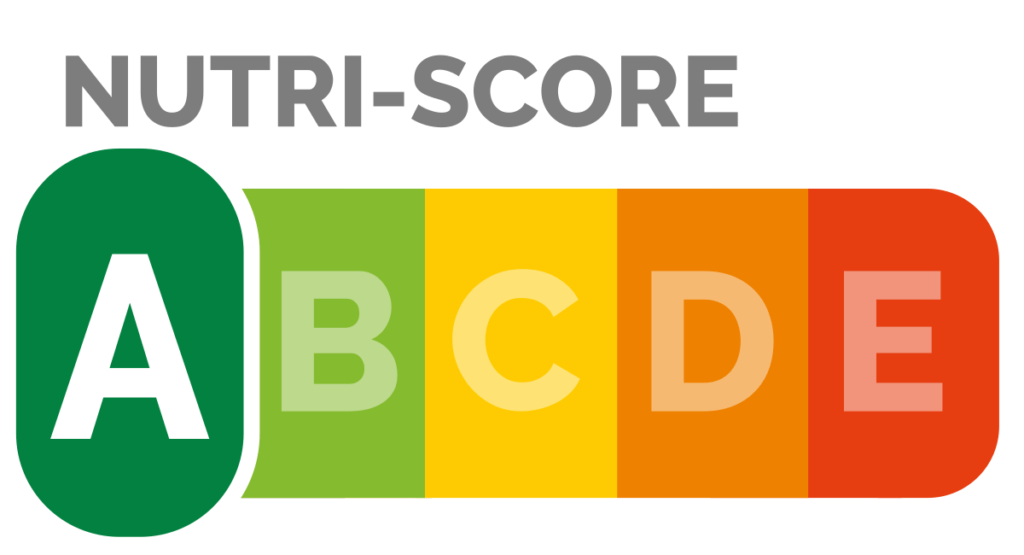
Photo by The RedBurn - Own work, CC BY-SA 4.0, https://commons.wikimedia.org/w/index.php?curid=81514581
Some clarification about the Nutri-Score:
First of all, the Nutri-Score is assigned according to a product’s nutritional qualities and is always calculated per 100 g of food.
Furthermore, it is calculated by taking into account, on the one hand, the positive points of the food product, namely the presence of: fiber, protein, fruit, vegetables, legumes, nuts, rapeseed oil, walnuts and olives. On the other hand, there are the negative points: calories, saturated fatty acids, sugar and salt.
Finally, it was designed to allow products within the same food category to be compared. Let’s take breakfast cereals, for example. Cereals from a brand known to everyone, whose name we will not mention but which starts with a K … (I mean Kellogg’s, not Kalisana, which is far more renowned, of course) would be given a D. Suffice it to say that their nutritional content places them at the bottom of the scale. And what is the point of having a full stomach for no more than one or two hours? Our Spring Granola, on the other hand, would undoubtedly be assigned the letter B (because it is calculated per 100 g of food. A 40–50 g serving, varying according to the build and athletic activity of individual X, would be more suitable for breakfast).
Having provided a non-exhaustive summary of this nutritional tool introduced to help consumers, we can now turn to the basics of nutritional labeling.
Some things are mandatory:
- The product name;
- The list of ingredients;
- The use-by date;
- The quantity;
- Storage and usage conditions;
- Instructions for use;
- The name and address of the manufacturer/packaging site/seller/distributor;
- The lot number;
- Nutritional values
One of the obligations listed above sometimes makes us want to tear our hair out, as it consists of an incalculable number of foods, additives, flavorings and more. It is none other than … the list of ingredients. The foods listed there are arranged in descending order of quantity. Thus, the first item on the list is the predominant one, and so on. In addition, the actual percentage is mandatory only for foods mentioned in the product name. This list sometimes contains additives and/or flavorings. The former, synthetic or natural, are intentionally added to foodstuffs to facilitate the manufacturing process, improve their appearance, taste, etc. They are legal and catalogued according to an assessment scale on the following website: https://www.quechoisir.org/dossier-additif-alimentaire-t139/
The latter add a modified smell and/or taste to products.
Thus, the food industry has gradually employed various strategies to manipulate consumers’ taste and enjoyment of food. This has affected not only people’s habits but also their eating sensations.
What if we reclaimed quality food, mindfully and without guilt?
Article written by | Dietitian and sports nutrition expert Kalisana
Find Kalisana’s Spring Granola at: https://www.nutri-bay.com/collections/kalisana