


Nutrition plan for a marathon by High5 [FRENCH VERSION]

What fuel for the body?
During a marathon, more than two-thirds of your energy can come from carbohydrates. Unfortunately, your body can store only a limited amount of carbohydrates, and as the kilometers go by, you will deplete this reserve. As your carbohydrate levels decrease, your energy also decreases, and it will become harder to maintain your initial pace. You may even hit the dreaded "wall", when your carbohydrate stores are so depleted that your muscles are forced to rely almost exclusively on fat as fuel.
The body struggles to convert fat into energy, making it difficult to continue running, regardless of the pace. To ensure optimal carbohydrate levels on race day, you need to carbohydrate-load in the days before your event and consume carbohydrates during the marathon.

(Source: https://highfive.co.uk/blogs)
During your Marathon
Think of your body's carbohydrate stores as a relatively small fuel tank that starts to empty when you begin running. Your muscles use carbohydrates quickly and can easily deplete this reserve during a marathon. If you supply your muscles with carbohydrates by consuming gel while running, they will draw less fuel from your carbohydrate reserve, and it will last longer. The aim of taking gel during the marathon is to delay the moment when you run out of fuel—until you cross the finish line.
It may seem logical that the more gel you can consume, the better—but be careful. You can consume (that is, swallow) a lot of gel, but your body can absorb only a maximum of 60 g per hour (up to 75 g if the gel contains caffeine). Consuming too much gel too quickly can and will cause stomach problems. On the other hand, taking a few gels after 17 miles, as some people do, will provide only a short-lived energy boost. Taking 2 or 3 gels every hour from the start of your event is optimal and means that by mile 17, you should have a large store of carbohydrates available for a strong finish.
Go 11 minutes faster
Recent research conducted during the Copenhagen Marathon showed that runners were, on average, 11 minutes faster when following our marathon nutrition guide on race day, with no additional training and no stomach problems.
Breakfast on race day

(Source: https://highfive.co.uk/blogs)
Breakfast should be light and high in carbohydrates. HIGH5 Sports Granola has been specially formulated to support your energy levels and reduce fatigue.
Drink 500ml of Energy Drink for an additional carbohydrate intake and to stay hydrated. Take an energy bar to eat on the way to the start.
Beginner runners

(Source: https://highfive.co.uk/blogs)
Take one Energy Aqua Gel Caffeine sachet every 30 minutes. Use a gel belt to carry your gels.
Experienced runners
If you fuel properly, you will give yourself the best chance of achieving that all-important new PB.
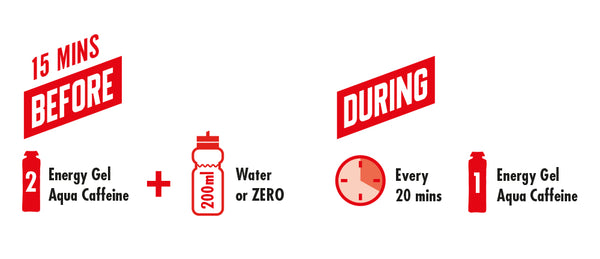
(Source: https://highfive.co.uk/blogs)
Take one Energy Aqua Gel Caffeine sachet every 20 minutes. If you find that 3 gels per hour is too much, try to consume as many gels as you can. Training with gels during long training runs makes them easier to use on race day. Use a gel belt to carry your gels.
Caffeine
Depending on body weight, there is a maximum number of Energy Aqua Gel Caffeine products you can take. All additional gels you consume should be Energy Gels Aqua (caffeine-free):

(Source: https://highfive.co.uk/blogs)
You can use Energy Gel Aqua instead of Energy Gel, according to your personal preferences. Both do the same job. Energy Gel Aqua has a lighter consistency, somewhere between a drink and a gel, and runners generally prefer it. Energy Gel is less bulky and lighter, making it easier to carry in large quantities.

(Source: https://highfive.co.uk/blogs)
Hydration
Your fluid requirements will depend on the temperature on race day and how much you sweat. Try to drink water or the course drink regularly. If you use the course drink, be careful not to consume too many additional carbohydrates from it, otherwise you will need to adjust your gel intake. In very hot conditions, you may need additional electrolytes. Individual ZERO tablets can be wrapped in cling film and carried during your race. Simply put the tablet into the course water to make a refreshing electrolyte drink. ZERO contains no carbohydrates.
At the finish
Drink 400ml of recovery drink as soon as you have finished. Drink another 400 ml one to two hours later and eat a balanced meal as soon as possible.

(Source: https://highfive.co.uk/blogs)
Good luck!
Caffeine note
If you have a medical condition, particularly high blood pressure, if you are pregnant, breastfeeding, or under 18, do not use caffeine. If you are sensitive to caffeine and experience a side effect, such as a higher-than-expected heart rate, stop using it immediately. If you do not wish to use caffeine for any reason, simply follow our marathon nutrition guidelines using a caffeine-free gel.
(Source: https://highfive.co.uk/blogs)
OUR HIGH5 CATALOG
You may also be interested in these articles: