shipping icon

pickup icon

Pyramidal Training: An Interesting Approach to Preparing for an Endurance or Ultra-Endurance Event, by Karoly Spy

In endurance training, it is well established that building an aerobic base, including a high volume of low-intensity training, is a priority (Seiler, 2016). 

Another important factor in endurance training is following the distribution of training intensities (TID). When referring to TID, we immediately think of the polarized method, which has become a trend in endurance sports training. 

"The concept of training intensity distribution (TID) is defined as the amount of exercise time an athlete spends in the different training intensity zones"

As a reminder, polarized training consists of spending:

  • 75–80% in Z1 (<SV1)
  • 5% in Z2 (between SV1 and SV2)
  • 15 to 20% in Z3 (>SV2)

According to this model, very little training time is devoted to moderate-intensity work (Z2) between the two thresholds (SV1 & SV2). 

As with any model, it is legitimate to ask whether polarized training is the best approach for all endurance disciplines and different competition formats.

A closer look at the various scientific studies on polarized training reveals that most were conducted on elite athletes in sports where the racing pace is above the second threshold (SV2), such as middle-distance running, track pursuit, or rowing.

Scientific studies on polarized training often compare this approach with the so-called “threshold” method, which consists of doing: 

  • 55 to 60% in Z1 (<SV1)
  • 40 to 45% in Z2 (between SV1 and SV2)
  • 0% in Z3 (>SV2)

2. Polarized vs. Threshold

Comparative studies between the Polarized model and the threshold model have shown that Z2 produces fewer beneficial effects on performance improvement, causes a high accumulation of fatigue, and therefore leads to poor assimilation of the training load. The various comparative studies therefore conclude that the threshold method is less effective and, above all, riskier than the polarized method for endurance athletes. Thus, polarized training would enable greater progress than threshold work! The polarized method has therefore become established over time among coaches and athletes, who have abandoned Zone 2 work in favor of Z1 and Z3.

But is Zone 2 really responsible for fatigue?! Isn’t it rather the distribution of intensities used in the threshold method that is responsible for developing harmful fatigue that prevents the athlete from assimilating the training load?

Looking at the training of Kenyan runners, we can see that they complete a large portion of their training in Zone 2, alongside a high volume of low-intensity work—the famous “aerobic base.” 

Here is an interesting point: the aerobic base is the central and primary factor in endurance training. It is what would enable the body to assimilate high-intensity sessions and produce improvement. 

Therefore, it may not actually be the Z2 work in the threshold method that causes problems, but rather the distribution percentage across each intensity zone. If we take the threshold model but replace Z2 with Z3, for example:

  • 55 to 60% in Z1
  • 0% in Z2
  • 40 to 45% in Z3

There is a strong chance that fatigue would be just as high, or even higher. 

In the Polarized method, it is certainly the aerobic base work (≈80% of training time) that is important. 

One could very well consider a different DIE model that would incorporate a larger share of work at moderate intensity (Z2), especially when considering the benefits it can provide for: 

  • Push back the fatigue threshold
  • Accumulate lactate 
  • Or by increasing cellular signaling via the cellular energy sensor AMPK.

Lactate is a central molecule for improving and performing in endurance sports:

Lactate is a major source of energy during exercise. Lactate is the main precursor of gluconeogenesis (the synthesis of glucose from a non-carbohydrate compound). Lactate is a signaling molecule that helps activate, among other things, PGC1-alpha (the conductor of mitochondrial biogenesis).

3. Pyramidal Training for Competitions >4h

Polarized training is a good approach for elite cyclists, since the time spent in Z1 is high during a race, with periods of high intensity at the end of the race to compete for the win. Take the Tour de France, for example: this is exactly what happens. The leaders stay in the peloton in Z1 by using drafting and shelter before attacking in the final 15–30 minutes. The Polarized model is therefore optimal for this category of competition. 

It has been demonstrated that the best cyclists are those capable of producing a high-intensity effort at the end of a race despite substantial pre-fatigue (Léo & al, 2020). It is therefore important to focus training on specific work designed to push back the fatigue threshold.

Looking at marathon runners, polarized training with low-intensity (Z1) and high-intensity (Z3) work would not allow them to train specifically at race pace (Z2) over a long period in order to generate the metabolic and muscular adaptations conducive to performance in this type of event. For a marathon runner training 6h/week, the distribution of training intensities would be as follows:

  • 4h30’ in Z1
  • 18’ in Z2
  • 1h12’ in Z3

We can immediately see that the time spent in Z2, the intensity specific to the marathon, is very short (18’) and will certainly not be enough to improve running economy at marathon pace. At the same time, the duration in Z3 corresponds to 2 sessions of 6*6’ Z3/ r 3’ Z1, which may expose the marathon runner to a high risk of injury, especially given the injury rate during marathon preparation. 

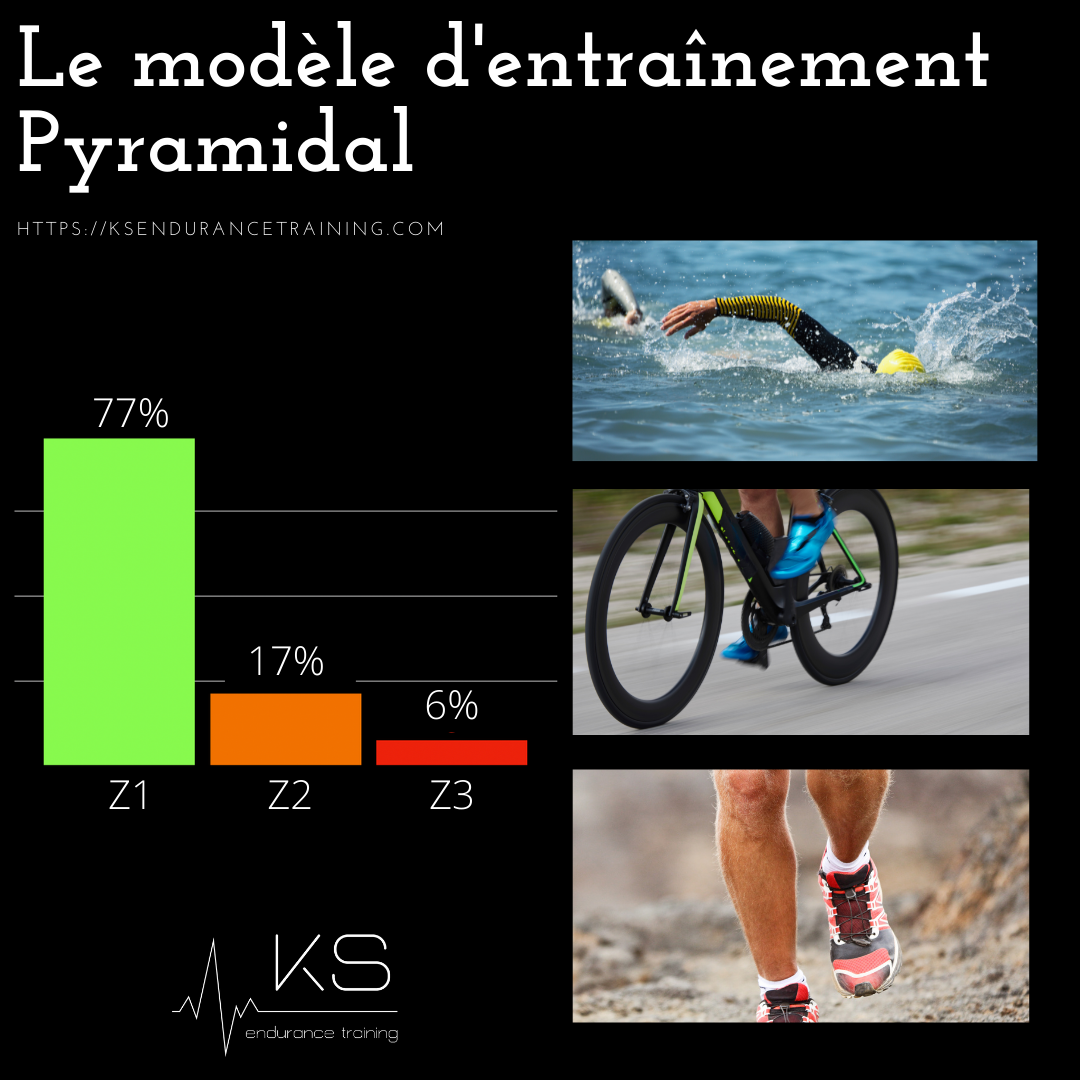
An alternative model is being increasingly highlighted and is used in endurance disciplines lasting >4h: Pyramidal training Pyramidal which involves completing a significant portion of basic aerobic training at low intensity (60 to 80%), but this time with an increased volume in Z2 (15 to 30%) and a smaller proportion at high intensity in Z3 (5-10%). Pyramidal training would therefore be better suited to the specific characteristics and demands of endurance and ultra-endurance races. 

“The Pyramidal model leads to improvements similar to those of the polarized model (Treff et al., 2017)”

A scientific study (Selles-Perez & al., 2019) compared the training of 2 groups over 20 weeks while preparing for a Half-Ironman-distance triathlon. 

  • Group 1 (POL) used the polarized method.
  • Group 2 (PYR) used the pyramidal method. 


What have we learned from this study ?

The PYR group performed better than the POL group during the competition, mainly during the running segment. It was found that the PYR group could remain in Z2 longer than the POL group. Indeed, the improvement in speed associated with SV2 in running  was statistically significant in the PYR group, whereas it was not statistically significant in the POL group. 

The study results suggest that the amount of training time spent in zone 2 is associated with better performance in a Half-Ironman race among amateur triathletes. They recommend focusing training on increasing the power or speed associated with this Z2 intensity in long-duration endurance events.

4. Is pyramid training effective for performing well?

All training approaches can lead to improvement and be effective; the key is knowing how to use them at the right times during preparation.

Take the example of Yannick MATEJICEK, a long-distance specialist triathlete whom I prepared using the Pyramidal method for his first Ironman in Vitoria, which he won in 7:28:27 (swimming canceled | cycling in 4:28:59 | marathon in 2:56:13).

As a reminder, an Ironman-format triathlon is an ultra-endurance event; several factors influence performance in this type of competition: 

  • Physiological
  • Nutritional
  • Energy cost 
  • Thermoregulation
  • Pacing strategy
  • … … … 


I will not present Yannick’s complete and detailed preparation, but will focus on the analysis of the Ironman event and the latest key sessions.

For IM preparation, I used exercise HRV via the DFA a1 index to estimate the SV1–SV2 thresholds, monitor fatigue levels, and analyze the sessions.

The HRV DFA alpha 1 index makes it possible to monitor autonomic nervous system regulation during endurance exercise.

There are 2 thresholds that delimit exercise intensities: 0.75 to estimate SV1 (referred to as HRVT1) and 0.5 to estimate SV2 (referred to as HRVT2).

Let us first analyze the Ironman : 

  • The cycling section 

Yannick completed most of the cycling course slightly above SV2, with an average DFA a1 of 0.46 (0.50 being correlated with SV2). 

  • The marathon

The marathon was run at 4:15/km, or 79.1% of critical speed (CV). A more detailed analysis shows that the first part (km 0 to km 21) was completed at 81.91% CV versus 76.4% for the second part (km 21 to km 42).

With an average DFA a1 index of 0.5, the marathon was run, on average, at SV2. 

It is interesting to observe ANS regulation, with an increase in DFA a1 that responded to the decrease in speed, particularly during the final 10 km.

This analysis of the Vitoria IM shows that Yannick completed the event, on average, at SV2.

Training volume during the last 5 training weeks (excluding race week) :

Stable training volume during the last 5 training weeks before the tapering phase. The choice was to have a cycling and running volume twice the IM distance. 

  • ≈70% of training time was devoted to the aerobic base (
  • ≈25% of the time was spent at SV2 
  • ≈5% of training time >SV2. Zone 3 (106–110% of critical intensity) was primarily completed in swimming and cycling to prevent injuries. New promising cycling sessions were completed to push back the tolerance threshold.

The latest key cycling training sessions :

  • J-21: 180 km, including 120 km at Tempo + 15 km in Z2, with an average DFA a1 index of 0.54 (including warm-up and recovery)
  • J-10: 150Km, including 100Km at Tempo, with an average DFA a1 index of 0.49 (including warm-up and recovery)

The last specific bike + running-at-Tempo brick session was completed at J-15; it included :

  • Cycling: 4h00’, including 2h30’ at Tempo + 30’ Z2. The average DFA a1 was 0.54, but a majority can be seen between SV1 and SV2 during the Tempo phase, with a period <0.50 (>SV2) during the Z2 block
  • The running section confirmed his fitness, with 15Km at 3’52’’/ KM, or 87% CS, close to the first part of the marathon, run at 81.91% CS, but after 180Km of cycling compared with 138Km during the bike-to-run transition, including 30Km at low intensity. 

Pyramidal training, with extensive work around SV2 to push back the fatigue tolerance threshold and improve efficiency, proved to be an effective training strategy that enabled Yannick to perform well in his first IronMan without suffering through the race.

Key takeaways : 

  • The aerobic base is the most important training factor in all endurance and ultra-endurance disciplines. Approximately 70 to 80% of training time should be devoted to low-intensity work.
  • That medium-intensity training (Z2) should not be neglected, as it helps athletes learn to maintain a high intensity over a long period by pushing back the fatigue tolerance threshold. 
  • That high-intensity training is valuable for achieving an additional performance breakthrough, especially among athletes who are already highly trained
  • Depending on the season, the Polarized model can be used during the winter before transitioning to the Pyramidal model as the goal approaches, as it is better suited to more specific training sessions and extensive work at race pace. 
  • The pyramidal model is particularly suited to athletes specializing in long-duration events (>4h). 
  • That it is essential to use the different training intensities, especially since they all share the common goal of increasing PGC1 alpha signaling, the conductor of the human body's energy system
This article was written by Karoly Spy, a coach specializing in endurance sports.
  • Founder of KS-Training in 2007 to support athletes in their performance goals
  • Founder of the GUTAÏ Training app (2016-2021)
  • Coach trainer
  • Technical Advisor for the Franche-Comté Triathlon League (2005-2007) and the Provence-Alpes Triathlon League (2007-2012)
  • Athletics club coach (Vitrolles, OM Athlé, SCO) and triathlon club coach

Visit its website: https://ksendurancetraining.com/ 

Discover our TRIATHLON collection

Thank you, it’s been saved!